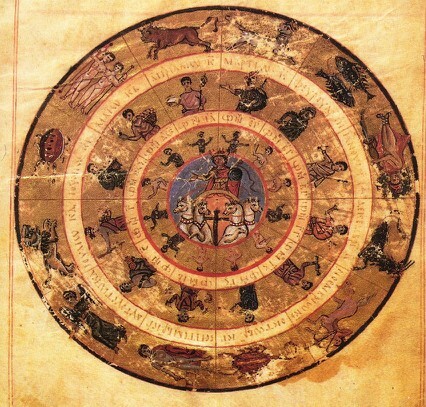
Philosophy
- Discipline (epistḗmē)
- Speculative (theōrēticós)
- Divine (theología)
- Mathematical (mathēmaticós)
- Natural (physiología)
- Practical (practicḗ)
- Civil (politicá)
- Economic (œconomía)
- Moral (ēthicḗ)
- Speculative (theōrēticós)
- Prædicable (prosēgoricá)
- Genus (génos)
- Species (ī̂dos)
- Difference (diaphorá)
- Property (ídion)
- Accident (symbebicós)
- Anteprædicamenta (legómena)
- Univocal (synṓnymos)
- Equivocal (homṓnymos)
- Denominative (parṓnymos)
- Prædicamenta (catēgoríæ)
- Substance (usía)
- Quantity (posón)
- Relation (prós ti)
- Quality (pϗn)
- Time (póte)
- Place (pû)
- Position (cī̂sthæ)
- Habit (échīn)
- Activity (pœeîn)
- Passion (páschīn)
- Cause (ǽtion)
- Matter (hýlē)
- Form (ī̂dos)
- Efficiency (cinûn)
- Perfection (télos)
Starting with being in the most generic sense, we may divide it positively into corporeal or negatively into incorporeal. That which is incorporeal then constitutes spirit, & that which is different as corporeal, body. We may then do the same with body into animate & inanimate, where the animate is life, & the inanimate, mineral. Again, with life, into sentient & insentient, which is animal & plant. Further again, animal into rational & irrational, i.e. man & beast.
Having differentiated from the most abstract—i.e. generic—to the most immanent—i.e. specific—we may no longer divide according to species, but enumeration, e.g. Peter, Paul, John &c.
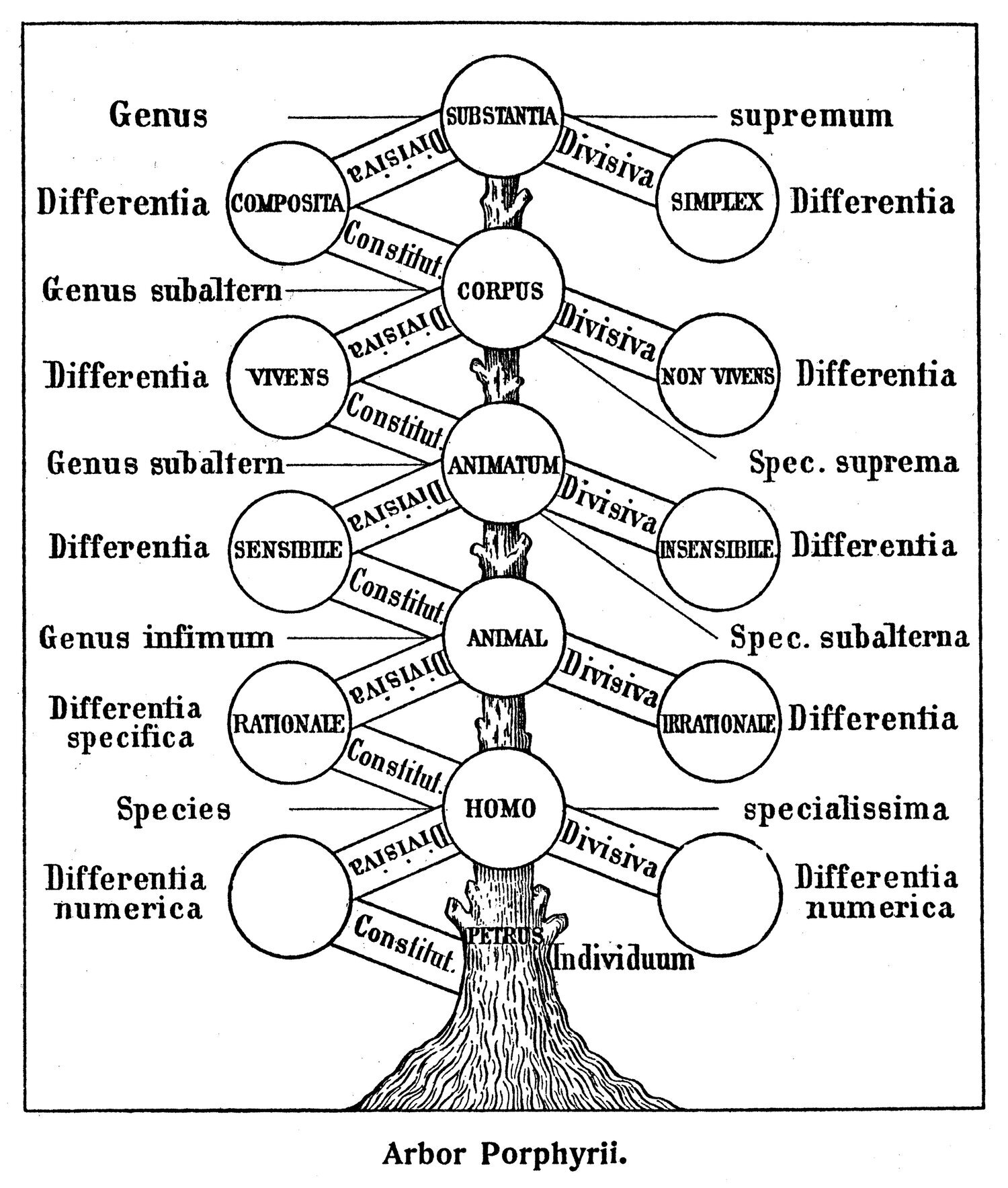
So we have then formed the image of a tree, with the most specific species as the roots, & the supreme genus as the tip.
Disciplines
Speculative
| Discipline | Subject |
|---|---|
| Divine | Spiritual |
| Mathematical | Abstract |
| Natural | Corporeal |
- Divine is also called metaphysics.
- Mathematics has four species: arithmetic, geometry, harmony, &
astronomy.
- Harmony is also called music.
- Contemporaneously differentiated from the geometry: mechanics & optics.
- Natural is also called physics.
- Contemporaneously differentiated from the natural: geology, biology.
- Species of biology: zoology, botany,
- Contemporaneously differentiated from the natural: geology, biology.
Practical
| Discipline | Subject |
|---|---|
| Civil | National |
| Economic | Domestic |
| Moral | Individual |
Prædicamenta
| Prædicament | E.g. |
|---|---|
| Substance | What is it being? |
| Quantity | How much is it? |
| Relation | To what is it? |
| Quality | Like what is it? |
| Time | When is it? |
| Place | Where is it? |
| Position | How is it doing? |
| Habit | How is it being? |
| Activity | What is it doing? |
| Passion | What is done to it? |
- Substance is also called nature & essence. Nature strictly means a substance taken with its properties, but it is not often if ever said strictly.
- Activity is also called operation.
Quanta
Discrete
| Quantum | E.g. |
|---|---|
| Number | I., II., III., &c. |
| Speech | A, B, C, D, &c. |
Continuous
| Quantum | E.g. |
|---|---|
| Time | Minute, hour, &c. |
| Space | Between surfaces. |
| Line | …of points. |
| Surface | …of lines. |
| Solid | …of surfaces. |
Unions
| Union | E.g |
|---|---|
| Substantial | …of hypostases. |
| Hypostatic | …of soul & body. |
| Stationary | …of judgements by will. |
| Welding | …of brass & lead. |
| Joining | …of stones & wood. |
| Mingling | …of wine & water. |
| Mixture | …of wheatmeal & water. |
| Fusion | …of wax & pitch. |
| Heaping | …of wheat & barley. |
| Coalescence | …of a brand & fire. |
Qualities
| Quality | I.e. |
|---|---|
| Habit | Uneasily changeable activity. |
| Disposition | Easily changeable activity. |
| Potency | Having that power. |
| Impotency | Not having that power. |
| Affection | Lightly acted upon. |
| Passivity | Firmly acted upon. |
| Shape | …of inanimate & animate bodies. |
| Form | …of only animate bodies. |
Causes
| Cause | E.g. |
|---|---|
| Matter | What is it made of? |
| Form | What is it made after? |
| Efficient | What is it made by? |
| Perfect | What is it made for? |
In the example of a table:
- The wood is the material cause.
- The carpenter’s plan is the formal cause.
- The carpenter’s tool is the efficient cause.
- The dinner is the perfect cause.
It needs be also said that the ancients used beget & create interchangeably, both meaning to make exist, e.g. Ac. 17:28. Only later, after Arius the Hæresiarch, did they restrict beget to be proper to nature, & create to operation.
Motions
| Substantial | Quantitative | Qualitative | Place |
|---|---|---|---|
| Generation | Increase | Alteration | Circular |
| Destruction | Decrease | Direct |
Nature
- Body (sō̂ma)
- Element (stœchī̂on)
- Fire (pŷr)
- Air (aḗr)
- Water (hýdōr)
- Earth (gē̂)
- Humour (chymós)
- Yellow Bile (xanthḕ cholḗ)
- Blood (hæ̂ma)
- Phlegm (phlégma)
- Black Bile (mélæna cholḗ)
- Colour (chrō̂ma)
- White (leucós)
- Flavin (xanthós)
- Ruby (erythrós)
- Purple (porphýra)
- Verdant (chlōrós)
- Cerulean (cyanós)
- Black (mélas)
- Organ (órganon)
- Eye (ophthalmós)
- Ear (ûs)
- Nose (rhís)
- Tongue (glō̂ssa)
- Brain (encéphalos)
- Ventricle (cœ̂los)
- Anterior (próteros)
- Interior (mésos)
- Posterior (hýsteros)
- Ventricle (cœ̂los)
- Lung (pneúmōn)
- Heart (cardía)
- Artery (artēría)
- Stomach (stómachos)
- Œsophagus (œsophágos)
- Liver (hē̂par)
- Vein (phléps)
- Gallbladder (cholēdóchos cýstis)
- Spleen (splḗn)
- Kidney (nephrós)
- Intestine (énteron)
- Genital (ædṓs)
- Testicle (órchis)
- Penis (phállos)
- Womb (mḗtra)
- Vagina (cólpos)
- Testicle (órchis)
- Part (méros)
- Bone (ostéon)
- Marrow (myelós)
- Muscle (mŷs)
- Joint (árthron)
- Sinew (neúra)
- Membrane (hymḗn)
- Skin (dérma)
- Hair (thríx)
- Nail (ónyx)
- Bone (ostéon)
- Member (mélos)
- Head (cephalḗ)
- Neck (tráchēlos)
- Chest (thōrax)
- Breast (stē̂thos)
- Back (nō̂tos)
- Belly (cœlía)
- Loin (osphýē)
- Arm (chī́r)
- Leg (scélos)
- Thigh (mērós)
- Knee (góny)
- Calf (cnḗmē)
- Foot (pús)
- Head (cephalḗ)
- Element (stœchī̂on)
- Spirit (pneûma)
- Intelligent (logisticón)
- Incensive (thymoīdés)
- Appetitive (epithymēticón)
- Soul (psychḗ)
- Intellect (nûs)
- Reason (diánœa)
- Conception (epínœa)
- Imagination (phantasía)
- Sense (ǽsthēsis)
- Vision (hórasis)
- Audition (acoḗ)
- Olfaction (ósphrēsis)
- Gustation (geûsis)
- Tactition (haphḗ)
Organs are also called viscera.
Sinews are also called tendons & nerves
Bodies
Proper to bodies only are change (e.g. of qualities), flux (e.g. of quantities), & separation (e.g. of substances).
The body (i.e. matter) exists as the concurrence of these qualities:
| Light | Heavy |
| Dense | Rare |
| Soft | Resistant |
| Fluid | Dry |
| Cold | Hot |
| Colour | Shape |
| Outline | Extension |
Note:
It should be understood these are in themselves not matter but, rather, bare concepts.
Elements
| Element | Attributes |
|---|---|
| Fire | Hot & Dry |
| Air | Hot & Wet |
| Water | Cold & Wet |
| Earth | Cold & Dry |
Fire is also called æther, but some consider æther a distinct quintessence.
The elements & the sense each is the mean of:
| Element | Sense |
|---|---|
| Fire | Vision |
| Air | Audition |
| Water | Olfaction |
| Earth | Gustation |
The sense of touch is usually omitted as a common background sense.
Humours
| Humour | Organ |
|---|---|
| Yellow Bile | Gallbladder |
| Blood | Liver |
| Phlegm | Brain |
| Black Bile | Spleen |
Vein
Food is chewed through the mouth, passed through the œsophagus in the throat, into the stomach, which then transforms what is nutritious into a liquid & gives it to the liver, but sends what is non-nutritious down to the intestine to be exited.
The liver transforms the liquid from the stomach into like itself—i.e blood—& further sends the fiery impurities to the gallbladder, but the earthy impurities to the spleen. The liver then distributes the blood throughout the body via the veins.
The kidneys catch the spent watery part of the blood, which acted as its vehicle along the veins & sends it down to the bladder to be exited.
Arteries
Air is inhaled through the nostrils, passed through the trachea artery in the throat into the lungs, which hold it & gives it to the heart, according to its rhythm.
The heart heats the air into breaht & distributes it throughout the body via the arteries, & takes the expired breath from the arteries & returns it to the lungs to be exited via exhalation.
As the arteries contract with pulsation the blood from the veins is drawn into the artery & infused with the breath, which is sent back out into the veins with pulsation.
Organs
| Organ | Sense |
|---|---|
| Eyes | Vision |
| Ears | Audition |
| Nostrils | Olfaction |
| Tongue | Gustation |
Brain
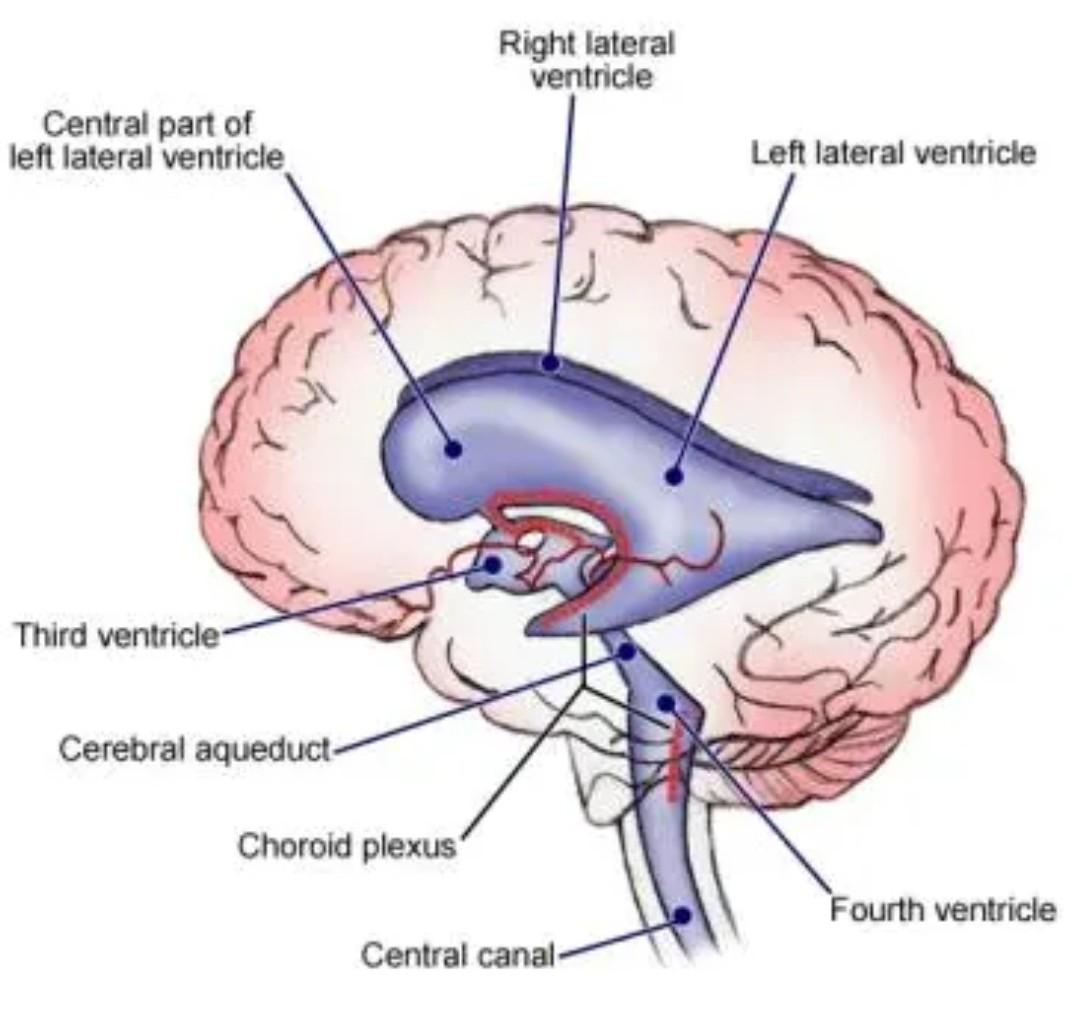
The ventricles of the brain & the faculty of each:
| Ventricle | Faculty |
|---|---|
| Anterior | Imagination |
| Interior | Reason |
| Posterior | Memory |
The divided senses are collected together in the imagination, which in the rational creature then communicates the common sense by the reason to the intellect.
Colours
| Colour | Element | Humour |
|---|---|---|
| ⬜ White | Air | Blood |
| 🟨 Flavin | Fire | Yellow Bile |
| 🟥 Ruby | ||
| 🟪 Purple | ─── | ─── |
| 🟩 Verdant | Water | Phlegm |
| 🟦 Cerulean | ||
| ⬛ Black | Earth | Black Bile |
White is the dilation of sight, & black is the contraction of it.
The colours flavin, ruby, purple, verdant, cerulean, &c. are ratios of white & black composited with elements or humours.
The meteorological & astronomical association of each colour:
| Colour | Hour | Planet |
|---|---|---|
| ⬜ White | Morning | ☾ |
| 🟨 Flavin | Noonday | 🜚 |
| 🟥 Ruby | Afternoon | ♂ |
| 🟪 Purple | Evening | ♃ |
| 🟩 Verdant | Sunset | ☿ |
| 🟦 Cerulean | Night | ♀ |
| ⬛ Black | Midnight | ♄ |
Soul
| Division | Locale |
|---|---|
| Intelligent | Head |
| Incensive | Bosom |
| Appetitive | Belly |
- The soul is the relation of body & spirit.
- The will is the rational & vital force proper to the intellect.
- Conception is also called opinion.
Faculties
| Rational | Irrational |
|---|---|
| Intellect | Imagination |
| Memory | Pulsation |
| Imagination | Vegetation |
- Pulsation is also called the vital principle.
- Vegetation may be divided into: semination, generation, & nutrition.
- Nutrition may be divided into: attraction, retention, transformation, & excretion, also called elimination.
Constitution
Ages
| Age | Year | Season |
|---|---|---|
| Child | 1 | Spring |
| Youth | 14 (12) | Summer |
| Adult | 26 (24) | Autumn |
| Elder | 60 | Winter |
(Woman)
Each age is characterized by the seasons, & the associated humour & element is predominantly created.
Melothesia
In regards to the number of parts in man’s body, they are astronomical:
- Planets—Two eyes, two nostrils, two ears, & one tongue, for a total of seven organs upon his face.
- Zodiac—Twelve ribs upon each side of his chest, mysteriously doubled.
- Decans—Three-hundred & sixty joints.
The planet associated with each feature upon the head & the body:
| Feature | Planet |
|---|---|
| Ears | ♄ ♂ |
| Eyes | 🜚 ☾ |
| Nose | ♀ |
| Tongue | ☿ |
| Hands | ♃ |
But the Chaldæans differ & rather associate these:
| Feature | Planet |
|---|---|
| Forehead | ♄ |
| Eyes | ♃ ♂ |
| Ears | 🜚 ♀ |
| Nose | ☿ |
| Tongue | ☾ |
The planet associated with each organ of the body:
| Organ | Planet |
|---|---|
| Spleen | ♄ |
| Liver | ♃ |
| Gallbladder | ♂ |
| Heart | 🜚 |
| Kidneys | ♀ |
| Lung | ☿ |
| Stomach | ☾ |
The zodiac associated with each region of the body:
| Member | Zodiac |
|---|---|
| Head | ♈︎ |
| Neck | ♉︎ |
| Arms | ♊︎ |
| Breast | ♋︎ |
| Back | ♌︎ |
| Belly | ♍︎ |
| Loins | ♎︎ |
| Genitals | ♏︎ |
| Thighs | ♐︎ |
| Knees | ♑︎ |
| Calves | ♒︎ |
| Feet | ♓︎ |
Climate
Corporeal constitutions are effected by each zone of the climates. Most notably, those are:
| Feature | Frigid | Temperate | Torrid |
|---|---|---|---|
| Stature | Large | Moderate | Small |
| Complexion | Pale | Olive | Dark |
| Hair | Straight | Curly | Woolly |
| Eyes | Recessed | Almond | Wide |
| Nose | Narrow | Aquiline | Broad |
| Lips | Thin | Full | Large |
- For frigid, cf. European nations.
- For temperate, cf. Mediterranean nations.
- For torrid, cf. African nations.
World
- World (cósmos)
- Age (æṓn)
- Firmament (steréōma)
- Heaven (uranō̂n)
- Star (astḗr)
- Constellation (asterismós)
- Zodiac (zōdiacós)
- Planet (planḗtēs)
- Temperament (crásīs)
- Benefic (agathopœō̂n)
- Malefic (cacopœō̂n)
- Tropical (tropicón)
- Fixed (stereō̂n)
- Bicorporeal (disṓmatōn)
- Gender (génos)
- Masculine (arsnicō̂n)
- Feminine (thēlicō̂n)
- Sect (hǽresis)
- Diurnal (hēmerinō̂n)
- Nocturnal (nycterinō̂n)
- Aspect (schēmatismō̂n)
- Conjuction (sýnodos)
- Opposition (diámetros)
- Trine (trígōnismos)
- Quartile (tetrágōnismos)
- Sextile (hexágōnismos)
- House (œ́cōn)
- Ascension (hýpsōsis)
- Descension (ptō̂sis)
- Temperament (crásīs)
- Constellation (asterismós)
- Time (chrónos)
- Year (étos)
- Solstice (tropḗ)
- Equinox (isēmería)
- Month (mḗn)
- Night (nýx)
- Day (hēméra)
- Hour (hṓra)
- Year (étos)
- Climate (clíma)
- Zone (zṓnē)
- Frigid (psychrós)
- Temperate (eúcratos)
- Torrid (causticós)
- Zone (zṓnē)
- Season (cærós)
- Spring (ánœxis)
- Summer (théros)
- Autumn (phthinópōro)
- Winter (chīmṓn)
- Wind (anémos)
Heavens
| Sphere | Motion |
|---|---|
| Stars | ← |
| Saturn | → |
| Jupiter | |
| Mars | |
| Sol | |
| Venus | |
| Mercury | |
| Luna | |
| Fire | ↑ |
| Air | |
| Water | ↓ |
| Earth |
The sphere of stars is called the firmament & the heaven of heavens or the third heaven. That of the planets is called the heavens or the second heaven. That of the elements is called heaven or the first heaven.
The stars move from east to west, but the planets from west to east. However, the motion of the stars being greater, the planets are carried with them. The elements of fire & air move upward, but water & earth move downward.
Some conceive the world as semi-concentric spheres moved around each other, where east & west, north & south, are intersecting circles. Some conceive the world as hemispheres instead, where east & west circle around north, but south, the extremity from the centre. Christians say either view is acceptable, but the Greeks only accept the former view. At any rate, each planet is moved in an additional sphere of its own within its respective sphere or hemisphere.
Constellations
| Northern Ecliptic | Northern Zodiac | Southern Zodiac | Southern Ecliptic |
|---|---|---|---|
| Ursa Minor (7+1) | Aries (13+5) | Libra (8+9) | Cetus (22) |
| Ursa Major (27+8) | Taurus (33+11) | Scorpio (21+3) | Orion (38) |
| Draco (31) | Gemini (18+7) | Sagittarius (31) | Eridanus (34) |
| Cepheus (11+2) | Cancer (9+4) | Capricorn (28) | Lepus (12) |
| Boötes (22+1) | Leo (27+5) | Aquarius (42+3) | Canis (18+11) |
| Corona (8) | Virgo (26+6) | Pisces (34+4) | Antecanis (2) |
| Hercules (17+1) | Argus (45) | ||
| Lyra (10) | Hydra (25+2) | ||
| Cygnus (17+2) | Crater (7) | ||
| Cassiopia (13) | Corvus (7) | ||
| Perseus (266+3) | Centaur (37) | ||
| Auriga (14) | Lupus (19) | ||
| Ophiuchus (24+5) | Ara (7) | ||
| Serpens (18) | Corona Australis (13) | ||
| Sagitta (5) | Piscis Austrinus (12+6) | ||
| Aquila (9+6) | |||
| Delphinus (10) | |||
| Equuleus (4) | |||
| Pegasus (20) | |||
| Andromeda (23) | |||
| Triangulum (4) |
(The first number, of formed stars, the second, of unformed.)
- Libra is also called Chelæ.
All the ancients were in harmony regarding the number of constellations: Forty eight. No more nor less. There was disagreement regarding what those were, but not how many.
Many constellations that are contemporaneously known are parts of these, e.g. the so called southern cross is really Centaur’s right hind leg.
Zodiac
| Sign | Name | Temperament | Gender | Sect |
|---|---|---|---|---|
| ♈︎ | Aries | Equinoctial | Masculine | Diurnal |
| ♉︎ | Taurus | Fixed | Feminine | Nocturnal |
| ♊︎ | Gemini | Bicorporeal | Masculine | Diurnal |
| ♋︎ | Cancer | Tropical | Feminine | Nocturnal |
| ♌︎ | Leo | Fixed | Masculine | Diurnal |
| ♍︎ | Virgo | Bicorporeal | Feminine | Nocturnal |
| ♎︎ | Libra | Equinoctial | Masculine | Diurnal |
| ♏︎ | Scorpio | Fixed | Feminine | Nocturnal |
| ♐︎ | Sagittarius | Bicorporeal | Masculine | Diurnal |
| ♑︎ | Capricorn | Tropical | Feminine | Nocturnal |
| ♒︎ | Aquarius | Fixed | Masculine | Diurnal |
| ♓︎ | Pisces | Bicorporeal | Feminine | Nocturnal |
Aspects
| Zodiac | Commands | Obeys | Beholds |
|---|---|---|---|
| ♈︎ | ♎︎ | ||
| ♉︎ | ♓︎ | ♍︎ | |
| ♊︎ | ♒︎ | ♌︎ | |
| ♋︎ | ♑︎ | ||
| ♌︎ | ♐︎ | ♊︎ | |
| ♍︎ | ♏︎ | ♉︎ | |
| ♎︎ | ♈︎ | ||
| ♏︎ | ♍︎ | ♓︎ | |
| ♐︎ | ♌︎ | ||
| ♑︎ | ♋︎ | ♒︎ | |
| ♒︎ | ♊︎ | ♑︎ | |
| ♓︎ | ♉︎ | ♏︎ |
Triplicities
| Zodiac | 🜚 Governor | ☾ Governor |
|---|---|---|
| ♈︎ ♌︎ ♐︎ | 🜚 ♃ | id. |
| ♉︎ ♍︎ ♑︎ | ♀ | ☾ |
| ♊︎ ♎︎ ♒︎ | ♄ | ☿ |
| ♋︎ ♏︎ ♓︎ | ♂ | ♀ |
Months
| Month | Days | Solstice | Zodiac |
|---|---|---|---|
| March | 31 | 21 | ♈︎ |
| April | 30 | 23 | ♉︎ |
| May | 31 | 23 | ♊︎ |
| June | 30 | 24 | ♋︎ |
| July | 31 | 25 | ♌︎ |
| August | 31 | 25 | ♍︎ |
| September | 30 | 25 | ♎︎ |
| October | 31 | 25 | ♏︎ |
| November | 30 | 25 | ♐︎ |
| December | 31 | 25 | ♑︎ |
| January | 31 | 25 | ♒︎ |
| February | 28 | 24 | ♓︎ |
The calendar year, i.e. the procession of the sun from one zodiac to the same, is so calculated:
- For the 36 non-zodiac constellations, each measures 10 days, called a decan, for a total of 360 days.
- For the 12 zodiac constellations, each measures 3 decans, called a month, for a total of 12 months.
- For the 5 planets, except the sun & the moon, 5 epagomenal days are observed,
i.e. 1/70 of 360.
- The Ægpytians add these to August, & Cæsar Augustus declared a sixth added every four years.
- The Romans add one day to every other month, subtract two from February, & double the 24th day of the same every four years.
The months are based on the zodiac—for in the passing of the sun from one sign to the next, the moon completes its circuit, whence in English month is named—but the order of names we have originate from Romulus (4793 AM). At first only ten months we counted (March to December), then Numa Pompilius (4837 AM), second king of Rome, added the other two. These months had insufficient days, wherefore intercalary months were inserted. Julius Cæsar counted the days as we do now, & ceased the insertion of intercalary months, rather counting February 24 twice every four years, which is called a bissextile.
According to Christians, the Archangel Uriel revealed the solar year to Enoch (†1487 AM), & he thence taught it to his descendants. But according to the gentiles, Zoroaster (c. 3897 AM) discovered it.
One of these months traditionally begins the year:
| Month | Significance |
|---|---|
| March | Spring |
| January | Consulship |
| September | Indiction |
The ancients always counted from March, while now it with January are only done by the gentiles, but Christians count from September.
To get the indiction for an AM year, calculate Y % 15, where Y stands for
the year. To get the same for an AD year, calculate ( Y + 3 ) % 15 + 1.
Because the indiction cycle began in 5821 AM, 3 is added so that ( 312 + 3 ) % 15 + 1 = 1.
The names of the months in other languages:
| Month | Ægyptian | Hebrew |
|---|---|---|
| March | Pharmuthi | Nisan |
| April | Pachon | Iares |
| May | Payni | Siuan |
| June | Epiphi | Thammuz |
| July | Mesore | Ari |
| September | Thoth | Elul |
| October | Phaophi | Theëliph |
| November | Athyr | Mersuan |
| December | Chœac | Chaseëlu |
| January | Tybi | Tybeth |
| February | Mechir | Sabat |
| March | Phamenoth | Adar |
- For Ægyptian, the epagomenal days are called Nesi.
- For Hebrew, these months have ancient names:
- Theëliph: Athanin
- Mersuan: Bul
Planets
| Sign | Name | Temperament | Gender | Sect |
|---|---|---|---|---|
| ♄ | Saturn | Malefic | Masculine | Diurnal |
| ♃ | Jupiter | Benefic | Masculine | Diurnal |
| ♂ | Mars | Malefic | Masculine | Nocturnal |
| 🜚 | Sol | Common | Masculine | Diurnal |
| ♀ | Venus | Benefic | Feminine | Nocturnal |
| ☿ | Mercury | Common | Common | Common |
| ☾ | Luna | Benefic | Feminine | Nocturnal |
- The qualities of Mercury are:
- When oriental—malefic, male, diurnal.
- When occidental—benefic, female, nocturnal.
A planet is oriental when rising & setting ahead of the sun, but occidental if following the sun.
The signs for each are from Roman astronomy:
| Sing | Meaning |
|---|---|
| ♄ | Ligature of κρ |
| ♃ | Ligature of ζε |
| ♂ | Spear |
| 🜚 | Ray |
| ♀ | Mirror |
| ☿ | Caduceus |
| ☾ | Crescent |
Before the planets were named after the gentile gods, they were called:
| Planet | Name |
|---|---|
| ♄ | Shining (phǽnōn) |
| ♃ | Radiant (phaéthōn) |
| ♂ | Fiery (pyóīs) |
| ♀ | Vesper |
| Lucifer | |
| ☿ | Twinkling (stílbōn) |
It needs must be said that the two contemporaneous so-called planets are not planets:
-
The first, Uranus, is really a star within the constellation Virgo, as Hipparchus & Claudius Ptolemy report. William Herschel (7331 AM) deviated: At first he said the star is a comet, but later contradicted himself & said it is a planet so the English might boast to the French of the false discovery.
-
The second, Neptune, is really a star within the constellation Pisces, if it exists at all. Urban Le Verrier (7386 AM) imagined this dim star as another planet so the French might boast to the English, in response to their prior false discovery.
Houses
| Planet | 🜚 House | ☾ House | Ascension | Descension |
|---|---|---|---|---|
| ♄ | ♑︎ | ♒︎ | ♎︎ | ♈︎ |
| ♃ | ♐︎ | ♓︎ | ♋︎ | ♑︎ |
| ♂ | ♏︎ | ♈︎ | ♑︎ | ♋︎ |
| 🜚 | ♌︎ | ♈︎ | ♎︎ | |
| ♀ | ♎︎ | ♉︎ | ♓︎ | ♍︎ |
| ☿ | ♍︎ | ♊︎ | ♍︎ | ♓︎ |
| ☾ | ♋︎ | ♉︎ | ♏︎ |
Orbits
How many days in which the planets complete their orbits:
| Planet | Deferent | Epicyclic |
|---|---|---|
| ♄ | 10,759 1/2 | 378 |
| ♃ | 4,333 1/2 | 399 |
| ♂ | 687 | 780 |
| 🜚 | 365 1/4 | ─── |
| ♀ | 224 1/2 | 584 |
| ☿ | 88 | 116 |
| ☾ | 27 1/3 | 29 1/2 |
- For Saturn: The deferent is commonly rounded to 30 years.
- For Jupiter: The deferent for is commonly rounded to 12 years.
- For Mars: The deferent & epicyclic is commonly rounded to 2 years.
The exact times calculated from the sexagesimal means for the deferent:
| Planet | Time |
|---|---|
| ♄ | 10,758 days, 17 hours, 48 minutes, 14.9 seconds |
| ♃ | 4,332 days, 18 hours, 9 minutes, 10.5 seconds |
| ♂ | 686 days, 23 hours, 31 minutes, 56.1 seconds |
| 🜚 | 365 days, 5 hours, 48 minutes, 45 seconds |
| ♀ | 224 days, 16 hours, 51 minutes, 56.8 seconds |
| ☿ | 87 days, 23 hours, 16 minutes, 42.9 seconds |
| ☾ | 27 days, 7 hours, 43 minutes, 12 seconds |
The exact times calculated from the sexagesimal means for the epicyclic:
| Planet | Time |
|---|---|
| ♄ | 378 days, 1 hour, 23 minutes, 45 seconds |
| ♃ | 398 days, 21 hours, 56 minutes, 45 seconds |
| ♂ | 779 days, 56 minutes |
| 🜚 | ─── |
| ♀ | 583 days, 22 hours, 1 minute, 29 seconds |
| ☿ | 115 days, 21 hours, 1 minute, 39 seconds |
| ☾ | 29 days, 12 hours, 44 minutes, 3 seconds |
The calendar dates for the ecclesiastical full moon:
| Number | Date |
|---|---|
| I | Apr. 5 |
| II | Mar. 25 |
| III | Apr. 13 |
| IV | Apr. 2 |
| V | Mar. 22 |
| VI | Apr. 10 |
| VII | Mar. 30 |
| VIII | Apr. 18 |
| IX | Apr. 7 |
| X | Mar. 27 |
| XI | Apr. 15 |
| XII | Apr. 4 |
| XIII | Mar. 12 |
| XIV | Apr. 12 |
| XV | Apr. 1 |
| XVI | Mar. 21 |
| XVII | Apr. 9 |
| XVIII | Mar. 29 |
| XIX | Apr. 17 |
To get the golden number for a year, calculate Y % 19 + 1, where Y stands
for the year.
Hours

Each hour from evening is associated with a planet, cycling through them all then in seven hours, so that the day is associated with the planet of its first hour:
| Day | I | II | III | IV | V | VI | VII | VIII | IX | X | XI | XII |
|---|---|---|---|---|---|---|---|---|---|---|---|---|
| First | 🜚 | ♀ | ☿ | ☾ | ♄ | ♃ | ♂ | 🜚 | ♀ | ☿ | ☾ | ♄ |
| ♃ | ♂ | 🜚 | ♀ | ☿ | ☾ | ♄ | ♃ | ♂ | 🜚 | ♀ | ☿ | |
| Second | ☾ | ♄ | ♃ | ♂ | 🜚 | ♀ | ☿ | ☾ | ♄ | ♃ | ♂ | 🜚 |
| ♀ | ☿ | ☾ | ♄ | ♃ | ♂ | 🜚 | ♀ | ☿ | ☾ | ♄ | ♃ | |
| Third | ♂ | 🜚 | ♀ | ☿ | ☾ | ♄ | ♃ | ♂ | 🜚 | ♀ | ☿ | ☾ |
| ♄ | ♃ | ♂ | 🜚 | ♀ | ☿ | ☾ | ♄ | ♃ | ♂ | 🜚 | ♀ | |
| Fourth | ☿ | ☾ | ♄ | ♃ | ♂ | 🜚 | ♀ | ☿ | ☾ | ♄ | ♃ | ♂ |
| 🜚 | ♀ | ☿ | ☾ | ♄ | ♃ | ♂ | 🜚 | ♀ | ☿ | ☾ | ♄ | |
| Fifth | ♃ | ♂ | 🜚 | ♀ | ☿ | ☾ | ♄ | ♃ | ♂ | 🜚 | ♀ | ☿ |
| ☾ | ♄ | ♃ | ♂ | 🜚 | ♀ | ☿ | ☾ | ♄ | ♃ | ♂ | 🜚 | |
| Sixth | ♀ | ☿ | ☾ | ♄ | ♃ | ♂ | 🜚 | ♀ | ☿ | ☾ | ♄ | ♃ |
| ♂ | 🜚 | ♀ | ☿ | ☾ | ♄ | ♃ | ♂ | 🜚 | ♀ | ☿ | ☾ | |
| Seventh | ♄ | ♃ | ♂ | 🜚 | ♀ | ☿ | ☾ | ♄ | ♃ | ♂ | 🜚 | ♀ |
| ☿ | ☾ | ♄ | ♃ | ♂ | 🜚 | ♀ | ☿ | ☾ | ♄ | ♃ | ♂ |
Climates
| Climate | Zone | Grade | Hours | Location |
|---|---|---|---|---|
| 66°8'40" | 24 | Arctic Circle | ||
| 63° | 20 | Iceland | ||
| 62° | 19 1/2 | Hebudes, Britain | ||
| 61° | 19 | Ireland Superior | ||
| 59° | 18 1/2 | Ireland Interior | ||
| 58° | 18 | Ireland Inferior | ||
| 57° | 17 3/4 | Catterick, Britain | ||
| 56° | 17 1/2 | York, Britain | ||
| 55° | 17 1/4 | Alborough, Britain | ||
| 54°1' | 17 | Azov, Russia | ||
| 52°50' | 16 3/4 | Netherlands | ||
| 51°6' | 16 1/2 | Cornwall, Britain | ||
| 50°4' | 16 1/4 | Donetsk, Russia | ||
| VII | Frigid | 48°32' | 16 | Nikolaev, Russia |
| 46°51' | 15 3/4 | Constantiana, Romania | ||
| VI | Temperate | 45°1' | 15 1/2 | Euxine Sea |
| 43°4' | 15 1/4 | Marseille, France | ||
| V | 40°46' | 15 | Hellespont, Turcia | |
| 38°35' | 14 3/4 | Smyrna, Turcia | ||
| IV | 36° | 14 1/2 | Rhodes, Greece | |
| 33°18' | 14 1/4 | Lebanon | ||
| III | Torrid | 30°22' | 14 | Giza, Ægypt |
| 27°12' | 13 3/4 | Thebes, Ægypt | ||
| II | 23°51' | 13 1/2 | Syene, Ægypt | |
| 20°14' | 13 1/4 | Nubia, Æthiopia | ||
| I | 16°27' | 13 | Meroë, Æthiopia | |
| 12° | 12 3/4 | Eritrea | ||
| 8°25' | 12 1/2 | Saylac, Somalia | ||
| 4°4' | 12 1/4 | Ceylon | ||
| 0° | 12 | Equator |
- The Tropic of Cancer is on Syene, Ægypt.
Seasons
| Season | Month | Solstice | Zodiac |
|---|---|---|---|
| Spring | March | 21 | ♈︎ |
| April | 23 | ♉︎ | |
| May | 23 | ♊︎ | |
| Summer | June | 24 | ♋︎ |
| July | 25 | ♌︎ | |
| August | 25 | ♍︎ | |
| Autumn | September | 25 | ♎︎ |
| October | 25 | ♏︎ | |
| November | 25 | ♐︎ | |
| Winter | December | 25 | ♑︎ |
| January | 25 | ♒︎ | |
| February | 24 | ♓︎ |
The hours of the days & nights of the months during each season:
| Season | Month | Day | Night |
|---|---|---|---|
| Spring | March | 12 | 12 |
| April | 13 | 11 | |
| May | 14 | 10 | |
| Summer | June | 15 | 9 |
| July | 14 | 10 | |
| August | 13 | 11 | |
| Autumn | September | 12 | 12 |
| October | 11 | 13 | |
| November | 10 | 14 | |
| Winter | December | 9 | 15 |
| January | 10 | 14 | |
| February | 11 | 13 |
The element strongest in & the humour the growth of which is promoted by each season:
| Season | Element | Humour |
|---|---|---|
| Spring | Air | Blood |
| Summer | Fire | Yellow Bile |
| Autumn | Earth | Black Bile |
| Winter | Water | Phlegm |
Winds
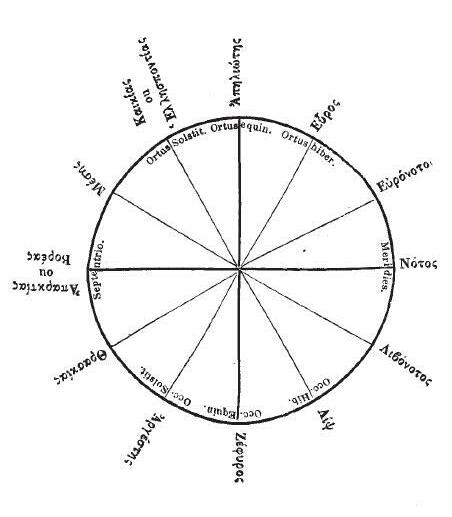
| Wind | Direction | Month | Zodiac |
|---|---|---|---|
| Cæcias | East-Northern | March | ♈︎ |
| Subsolanus | Eastern | April | ♉︎ |
| Vulturnus | East-Southern | May | ♊︎ |
| Euroauster | South-Eastern | June | ♋︎ |
| Auster | Southern | July | ♌︎ |
| Austroafricus | South-Western | August | ♍︎ |
| Africus | West-Southern | September | ♎︎ |
| Favonius | Western | October | ♏︎ |
| Corus | West-Northern | November | ♐︎ |
| Circius | North-Western | December | ♑︎ |
| Septentrio | Northern | January | ♒︎ |
| Aquilo | North-Eastern | February | ♓︎ |
These winds also are called:
- Cæcias – Hellespontus,
- Subsolanus – Apeliotes
- Vulturnus – Eurus
- Euroauster – Euronotus, Phœnicias
- Auster – Notus
- Austroafricus – Libonotus, Altanus, Leuconotus
- Africus – Lips
- Favonius – Zephyrus
- Corus – Argestes, Iapyx, Olympias
- Circius – Thrascias
- Septentrio – Aparctias
- Aquilo – Meses, Boreas
What each wind brings in thier due season:
| Wind | Direction | Weather | Season |
|---|---|---|---|
| Cæcias | East-Northern | Spring | |
| Subsolanus | Eastern | Rain | |
| Vulturnus | East-Southern | ||
| Euroauster | South-Eastern | Summer | |
| Auster | Southern | Thunder | |
| Austroafricus | South-Western | ||
| Africus | West-Southern | Autumn | |
| Favonius | Western | Hail | |
| Corus | West-Northern | ||
| Circius | North-Western | Winter | |
| Septentrio | Northern | Snow | |
| Aquilo | North-Eastern |
The origin of each of the winds:
| Name | Location |
|---|---|
| Cæcias | Caspian Sea |
| Subsolanus | Bactria |
| Vulturnus | India |
| Euroauster | Erythræan Sea |
| Auster | Æthiopia |
| Austroafricus | Garamantia |
| Africus | Libya |
| Favonius | Pillars of Hercules |
| Corus | Hispania |
| Circius | Gallia |
| Septentrio | Scythia |
| Aquilo | Pontus |
Contemporaneous names used by mariners:
| Name | Wind |
|---|---|
| Levante | Subsolanus |
| Scirocco | Euroauster |
| Ostro | Auster |
| Libeccio | Africus |
| Ponente | Favonius |
| Mistral | Corus |
| Tramontana | Septentrio |
| Greco | Aquilo |
Measures
- Lengths
- Digit (dáctylos)
- Palm (palæstḗ)
- Span (spithamḗ)
- Foot (pûs)
- Cubit (pē̂chys)
- Pace (bē̂ma)
- Fathom (orgyiá)
- Perch (decápodon)
- Furlong (strémma, pléthron)
- Stadium (stádion)
- Mile (mílion)
- Area
- Acre (strémma)
- Weights
- Scruple (grámma)
- Semis (sēmmísis)
- Solidus (nómisma)
- Ounce (ungía)
- Pound (lítra)
- Volumes
- Cup (cotýlē)
- Pot (xéstēs)
- Handful (phûcta)
The foot was standardized by that of Agrippa—general of Emperor Augustus, & husband of his daughter Julia the Elder—when he built what would become the Church of the Mother of God & the Martyrs, Italy.
Lengths
| Measure | Definition | Equals (ft.) | Equals (dig.) |
|---|---|---|---|
| Digit | = 1 digit | = 1/16 ft. | = 1 dig. |
| Palm | = 4 digits | = 1/4 ft. | = 4 dig. |
| Span | = 3 palms | = 3/4 ft. | = 12 dig. |
| Foot | = 4 palms | = 1 ft. | = 16 dig. |
| Cubit | = 2 spans | = 1 1/2 ft. | = 24 dig. |
| Pace | = 2 1/2 feet | = 2 1/2 ft. | = 40 dig. |
| Double Pace | = 5 feet | = 5 ft. | = 80 dig. |
| Fathom | = 8 spans | = 6 ft. | = 96 dig. |
| Perch | = 10 feet | = 10 ft. | = 160 dig. |
| Furlong | = 10 perches | = 100 ft. | = 1,600 dig. |
| Stadium | = 6 furlongs | = 600 ft | = 9,600 dig. |
| Mile | = 8 1/3 stadia | = 5,000 ft. | = 80,000 dig. |
| Day’s Journey | = 3 miles | = 150,000 ft. | |
| Week’s Journey | = 21 miles | = 1,050,000 ft. |
- The digit is also called the finger & unit.
- The palm is also called the handbreadth.
- The perch is also called the rod.
- The stadium is now called the cable.
- The knuckle equals 2 dig. (i.e. 1/8 ft.).
- Conversion of contemporaneous lengths:
| Measure | Definition | Equals (ft.) | Equals (dig.) |
|---|---|---|---|
| Inch | = 1/12 foot | = 1/12 ft. | = 1 1/2 dig. |
| Yard | = 1/2 fathom | = 3 ft. | = 48 dig. |
| League | = 1 1/2 miles | = 7,500 ft. | = 120,000 dig. |
- The English furlong equals 1 stadium.
- The English mile equals 8 fur. (i.e. 5,280 ft).
- The French meter equals 3 7/25 ft.
Area
| Measure | Definition | Equals (ft.) |
|---|---|---|
| Acre | = 1×1 furlong | = 100×100 ft. |
- The English acre equals 4 ac.
Weights
| Measure | Definition | Equals (lb.) |
|---|---|---|
| Scruple | = 1/24 ounce | = 3/64 lb. |
| Semis | = 1/12 ounce | = 5/64 lb. |
| Solidus | = 1/6 ounce | = 1/72 lb. |
| Ounce | = 1 ounce | = 1/12 lb. |
| Pound | = 12 ounces | = 1 lb. |
- Conversion of contemporaneous weights:
| Measure | Definition | Equals (lb.) |
|---|---|---|
| Carat | = 1/144 ounce | = 1/1,728 lb. |
| Obole | = 1/48 ounce | = 1/64 lb. |
Volumes
| Measure | Definition | Equals (lb.) |
|---|---|---|
| Ounce | = 1 ounce | = 1/12 lb. |
| Cup | = 1 1/2 ounces | = 1/8 lb. |
| Pot | = 3 ounces | = 1/4 lb. |
| Pound | = 12 ounces | = 1 lb. |
| Handful | = 18 1/2 ounces | = 1 13/34 lbs. |
- Conversion of contemporaneous volumes:
| Measure | Definition | Equals (oz.) |
|---|---|---|
| Pint | = 1/2 quart | = 2 1/4 oz. |
| Quart | = 1/4 gallon | = 4 1/2 oz. |
| Gallon | = 6 pots | = 18 oz. |
- The English ounce is 1/16 of a pint.
Miscellaneous
Grammar
- Letter (grámma)
- Vowel (phōnḗnta)
- Consonant (sýmphōnon)
- Mute (áphōna)
- Tenuis (psilà)
- Medial (mesǽ)
- Aspirate (daséa)
- Liquid (rheusta)
- Nasal (rhinicá)
- Semivowel (hēmíphōna)
- Mute (áphōna)
- Syllable (syllabḗ)
- Word (léxis)
- Sentence (lógos)
- Class (táxis)
- Noun (ónoma)
- Verb (rhḗma)
- Participle (metochḗ)
- Article (árthron)
- Pronoun (antōnymía)
- Preposition (próthesis)
- Adverb (epírrhēma)
- Conjunction (sýndesmos)
- Gender (génos)
- Masculine (arsenicón)
- Feminine (thēlycón)
- Neutral (udèteron)
- Number (arithmós)
- Singular (enicós)
- Dual (dyïcós)
- Plural (plēthynticós)
- Case (ptō̂sis)
- Nominative (onomasticḗ)
- Genitive (genicḗ)
- Dative (doticḗ)
- Accusative (ætiaticḗ)
- Vocative (clēticḗ)
- Person (prosōpicós)
- First (prō̂tos)
- Second (deúteros)
- Third (trítos)
- Accent (tónos)
- Acute (oxī̂a)
- Circumflex (perispōménē)
- Grave (barī̂a)
- Rough Breath (dasỳ pneûma)
- Smooth Breath (psīlòn pneûma)
- Tréma (diǽresis)
- Macron (macrón)
- Breve (brachý)
Vowels
| Long | Brief | Common | Diphthong |
|---|---|---|---|
| ─ | e | a | ae |
| ─ | o | i | ei |
| u | oe | ||
| au | |||
| eu | |||
| ou |
- The letters a i u are short but long before double consonants.
- The two long vowels in Latin must be accented: ē ō
- The letter i including: y
Consonants
| Double | Liquid | Nasal | Semivowel |
|---|---|---|---|
| z | l | m | i |
| x | r | n | u |
| ─ |
- The third double consonant in Latin must be written: ps
- The letter z being: sd
- The letter x being: cs
Mutes
| Tenuis | Medial | Aspirate |
|---|---|---|
| p | b | ph |
| c | g | ch |
| t | d | th |
- The letter c including: k q
- The letters ph including: f
- The letters ch including: h
Classes
| Class | E.g |
|---|---|
| Noun | man, horse |
| Proper Noun | Peter, Paul |
| Verb | strike |
| Participle | trusting |
| Article | the |
| Pronoun | he |
| Preposition | in, at, from |
| Adverb | here, wastely |
| Conjunction | and, but, or, so |
These nine classes ultimately revert to two: The verb & noun, the pronoun & adverb from the noun, the participle from both the verb & noun, the article from preposition, & the conjunction from these.
Pronouns
| Gender | Number | Person | Nominative | Genitive | Dative | Accusative |
|---|---|---|---|---|---|---|
| Sn. | I. | I | my, mine | to me | me | |
| II. | thou | thy, thine | to thee | thee | ||
| Masc. | III. | he | his | to him | him | |
| Fem. | she | hers | to her | her | ||
| Neut. | it, that | its | to it | it | ||
| Pl. | I. | we | our | to us | us | |
| II. | you | your | to ye | ye | ||
| III. | those, they | their | to them | them | ||
| which, who | whose | to whom | whom |
Cases
| Case | E.g. |
|---|---|
| Nominative | he is working |
| Generic | his hands |
| Dative | speaking to him |
| Accusative | hearing him |
| Vocative | then, Peter |
- The vocative was assumed into the nominative & accusitive.
Although all of these are examples of the third person male singular pronoun, the last needs must, for our language, be a proper noun.
Accents
| Sign | Name | Meaning |
|---|---|---|
| ⠀́ | Acute | Stress vowel. |
| ⠀̂ | Circumflex | Stress vowel. |
| ⠀̀ | Grave | Destress vowel. |
| ⠀̈ | Tréma | Separate vowel. |
| ⠀̔ | Rough Breath | Aspirate vowel. |
| ⠀̓ | Smooth Breath | Deaspirate vowel. |
| ⠀̄ | Macron | Lengthen vowel. |
| ⠀̆ | Breve | Shorten vowel. |
- The circumflex is only placed on long vowels.
- The acute sign is placed on short vowels.
- In Latin, the rough & smooth breaths are not written.
In prior times the circumflex was written ~, & the rough & smooth breath marks, ⊢ & ⊣.
Rhetoric
- Rhetoric (rhētoricḗ)
- Genera (génos)
- Deliberative (symbuleuticón)
- Demonstrative (epidīcticón)
- Judicial (dicanicón)
- Persuasions (pístis)
- Moral (ē̂thos)
- Passion (páthos)
- Reason (lógos)
- Canons (—)
- Invention (—)
- Disposition (—)
- Elocution (—)
- Memory (—)
- Pronunciation (—)
- Genera (génos)
Pronunciation is sometimes called action.
Harmony
- Interval (diástēma)
- Sound (phōnḗ)
- Point (mórion)
- Semitone (hēmitónio)
- Whole Tone (tónos)
- Fourth (diatessárōn)
- Fifth (diapénte)
- Tetrachord (tetráchordon)
- Octave (diapasō̂n)
- Unison (tautophōnía)
- Scale (gènos)
- Diatonic (diatonicó)
- Chromatic (chrōmaticó)
- Enharmonic (enarmónio)
- Mode (ḗchos)
- First (prō̂tos)
- Second (deúteros)
- Third (trítos)
- Fourth (tétartos)
- Plagal First (plágios tû prṓtu)
- Plagal Second (plágios tû deutéru)
- Grave (barýs)
- Plagal Fourth (plágios tû tetártu)
- Neume (pneûma)
- Ison (íson)
- Oligon (olígon)
- Petasté (petastḗ)
- Centemata (centḗmata)
- Centema (céntēma)
- Hypselé (hypsēlḗ)
- Apsotrophe (apóstrophos)
- Hyporroé (hyporroḕ)
- Elaphron (elaphrón)
- Chamelé (chamēlḗ)
- Clasma (chlásma)
- Aplé (aplḗ)
- Diplé (diplḗ)
- Triplé (triplḗ)
Intervals
| Interval | Value/Ratio |
|---|---|
| Point | = 1 |
| Semitone | = 3 |
| Whole Tone | = 6 |
| Fourth | 4:3 |
| Octave | 2:1 |
| Unison | 1:1 |
- The octave is composed of a whole tone between two tetrachords.
Tones
| pa | bu | ga | di | ce | zō | nē |
From Chrysanthus of Mandytus (†7355 AM), following St. John Cucuzeles (†6869 AM), & SS. John of Damascus (†6258 AM) & Cosmo the Hymnographer (†6260 AM).
Solfeggio
| do | re | mi | fa | sol | la | si |
From Guido of Arezzo (†6542 AM), originally beginning with ut & ending with la, but Giovanni Battista Doni (7156 AM) changed the first syllable to do & added si.
The syllable do here corresponds to nē above.
Scales
| Diatonic | Soft Chromatic | Hard Chromatic | Enharmonic | ||||
|---|---|---|---|---|---|---|---|
| pa | (─) | nē | (─) | pa | (─) | nē | (─) |
| bu | (12) | pa | (8) | bu | (6) | pa | (12) |
| ga | (10) | bu | (14) | ga | (20) | bu | (12) |
| di | (8) | ga | (8) | di | (4) | ga | (6) |
| ce | (12) | di | (12) | ce | (12) | di | (12) |
| zō | (12) | ce | (8) | zō' | (6) | ce | (12) |
| nē' | (10) | zō' | (14) | nē' | (20) | zō' | (12) |
| pa' | (8) | nē' | (8) | pa' | (4) | nē' | (6) |
(Interval points from the prior.)
Modes
| Mode | Scale | Tone |
|---|---|---|
| First | Diatonic | pa |
| Second | Soft Chromatic | di |
| Third | Enharmonic | ga |
| Fourth | Diatonic | bu, pa, di |
| Plagal First | Diatonic | pa, ce |
| Plagal Second | Hard Chromatic | pa |
| Grave | Enharmonic | ga, zō |
| Plagal Fourth | Diatonic | nē, ga |
The first four modes are, by some, called the authentic modes, with the last four called the plagal modes.
The modes are also, by some, called by the names of the ancient Greek modes:
| Mode | Greek Name |
|---|---|
| First | Dorian |
| Second | Phrygian |
| Third | Lydian |
| Fourth | Mixolydian |
| Plagal First | Hypodorian |
| Plagal Second | Hypophrygian |
| Grave | Hypolydian |
| Plagal Fourth | Hypomixolydian |